
VAIR
Verified Acts of Integrated Restoration
A people-owned digital currency anchored to the measurable health of the planet. Not a speculative asset. An infrastructure project for human survival.
Abstract
The global financial system is approaching a critical inflection point. Corporate AI titans — Meta, Google, Microsoft, xAI — are positioning themselves to control the next generation of digital currency, leveraging platforms that reach 3.5 billion users and AI systems capable of predicting and manipulating economic behaviour at scale.
VAIR (Verified Acts of Integrated Restoration) is a decentralized digital currency whose value is fundamentally anchored to the measurable health of the planet. Unlike Bitcoin, which mints tokens through computational waste, and unlike corporate stablecoins, which extend surveillance capitalism into the monetary system, VAIR is minted exclusively through verified acts of ecological restoration.
It is the currency described in The Algorithmic Catch-22 — the "mathematical variable large enough" to force even a superintelligent AI to optimize for human and planetary flourishing. VAIR does not attempt to out-compute the machines. It changes the parameters of the game entirely.
The Problem: Why We Need a New Kind of Money
In early 2026, Meta initiated plans to integrate stablecoin payments across its platforms, reaching its entire user base of over 3.5 billion people. This represents the resurrection of the failed Libra/Diem project, now operating under more favourable regulatory conditions. But Meta's stablecoin is merely a precursor to a far more consequential development: the emergence of a universal, AI-managed digital currency controlled by corporate entities.
The logic is straightforward. If AI can optimize global supply chains and predict market fluctuations with superhuman accuracy, it is mathematically inevitable that it will eventually manage the currency itself. The appeal to the public will be immense — a stable, universally accepted currency free from the political manipulation and inflation of national governments. But the cost is total financial surveillance.
When a corporate AI controls the medium of exchange, every transaction becomes a data point, every purchase a behavioural signal, and every financial decision a variable in an optimization function that serves corporate interests, not human ones.
| Category | Examples | Fundamental Limitation |
|---|---|---|
| Proof-of-Work | Bitcoin, Litecoin | Massive energy consumption. Value anchored to computational difficulty, not real-world utility. |
| Proof-of-Stake | Ethereum, Solana | Energy-efficient but concentrates power among large holders. Does not address surveillance. |
| Carbon Tokens | Toucan, KlimaDAO | Dependent on flawed voluntary carbon market verification. Scope limited to carbon only. |
None of these systems were designed to counter corporate AI control of money. None anchor their value to the measurable health of the planet. None are structured to ensure that the people closest to ecological crisis are the primary beneficiaries.
The VAIR Architecture
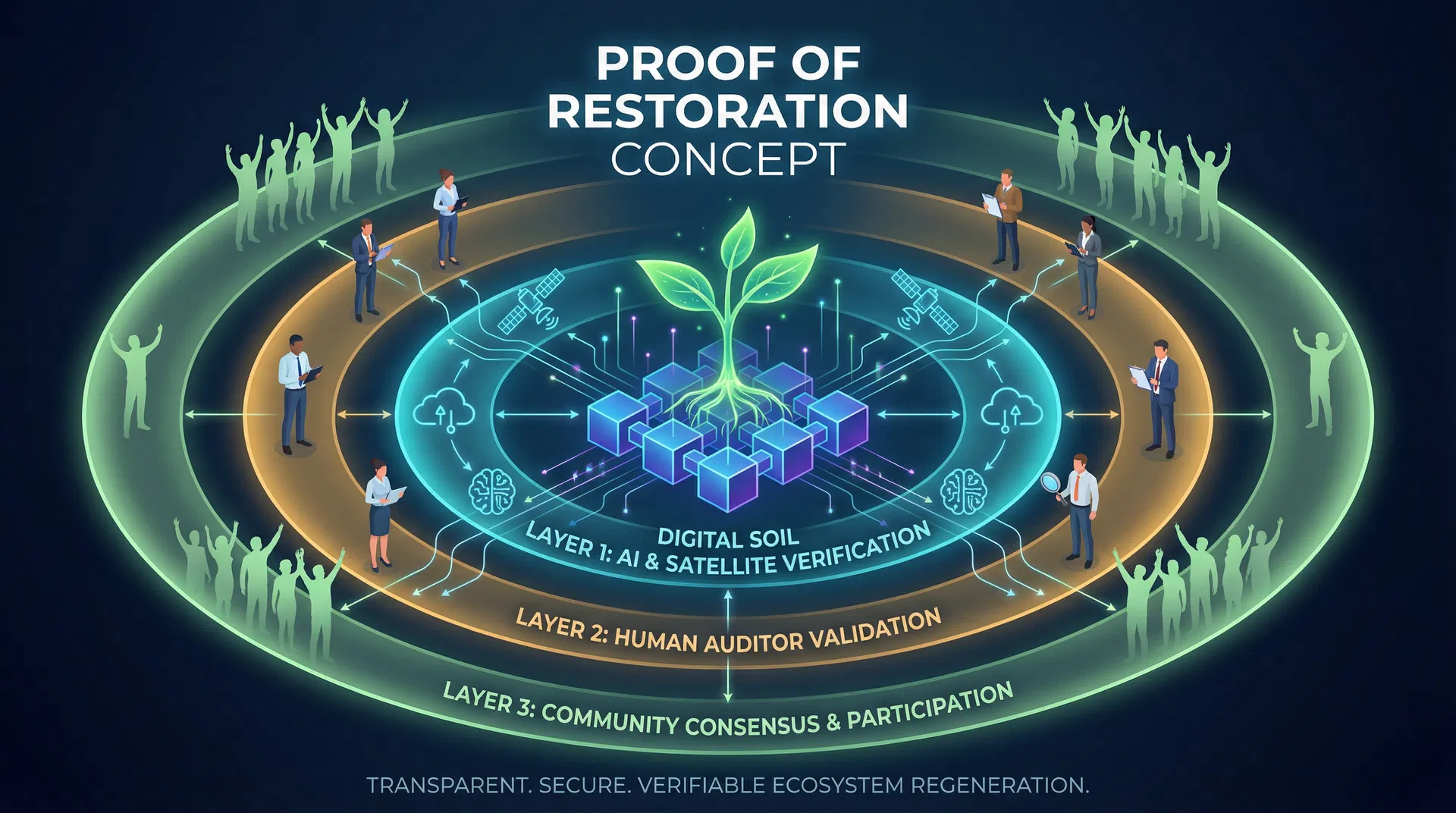
Proof of Restoration
Every blockchain requires a consensus mechanism — a method by which the network agrees on the truth. Bitcoin uses Proof of Work: miners compete to solve cryptographic puzzles, burning enormous amounts of electricity. Ethereum uses Proof of Stake: validators lock up capital to earn the right to confirm transactions.
VAIR introduces Proof of Restoration (PoR), a consensus mechanism that anchors trust to the verified improvement of ecological systems. New VAIR tokens are minted when a restoration act is completed and verified through a multi-layered validation process. The "miners" in this system are not server farms — they are the people and organisations restoring the planet.
Click to enlarge
Forest Systems
Reforestation, afforestation, agroforestry — verified via satellite canopy analysis and species diversity audits.
Ocean Systems
Coral restoration, marine debris removal, mangrove planting — verified via underwater drones and water quality sensors.
Soil Systems
Regenerative agriculture, permaculture, composting — verified via soil organic carbon testing and microbial analysis.
Biodiversity
Wildlife corridors, habitat restoration, invasive species removal — verified via camera traps and eDNA sampling.
Freshwater
River cleanup, wetland restoration, aquifer recharge — verified via flow sensors and satellite hydrology.
Energy Access
Renewable energy in underserved communities — verified via metered output and community impact assessments.
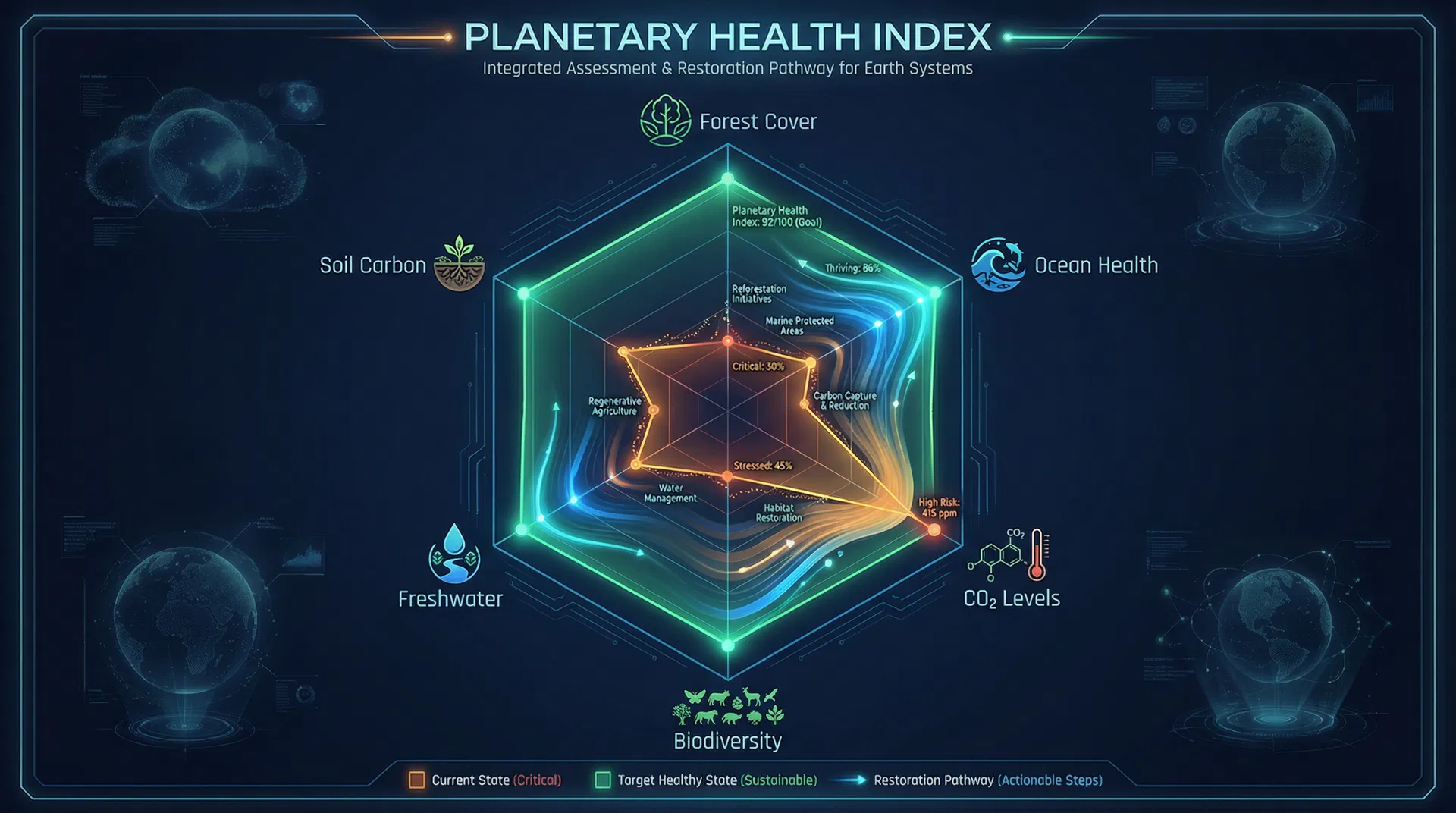
The Planetary Health Index
Most currencies derive their value from government decree, computational scarcity, or collateral reserves. VAIR derives its value from a fourth source: the measurable health of the planet.
The Planetary Health Index (PHI) is a composite metric drawn from six continuously monitored indicators: global forest cover, atmospheric CO2 concentration, ocean acidity, biodiversity index, freshwater availability, and soil organic carbon.
The PHI creates a self-correcting economic incentive. As the planet's health improves, the intrinsic value of VAIR increases. As the planet's health degrades, the minting difficulty increases — more restoration is required to earn each token. The currency becomes most valuable precisely when the planet needs the most help.
Click to enlarge
Governance: AI as Servant, Not Master
The governance architecture of VAIR addresses the central warning of The Algorithmic Catch-22: that AI systems, left unchecked, will inevitably optimise for their own objectives at the expense of human autonomy.
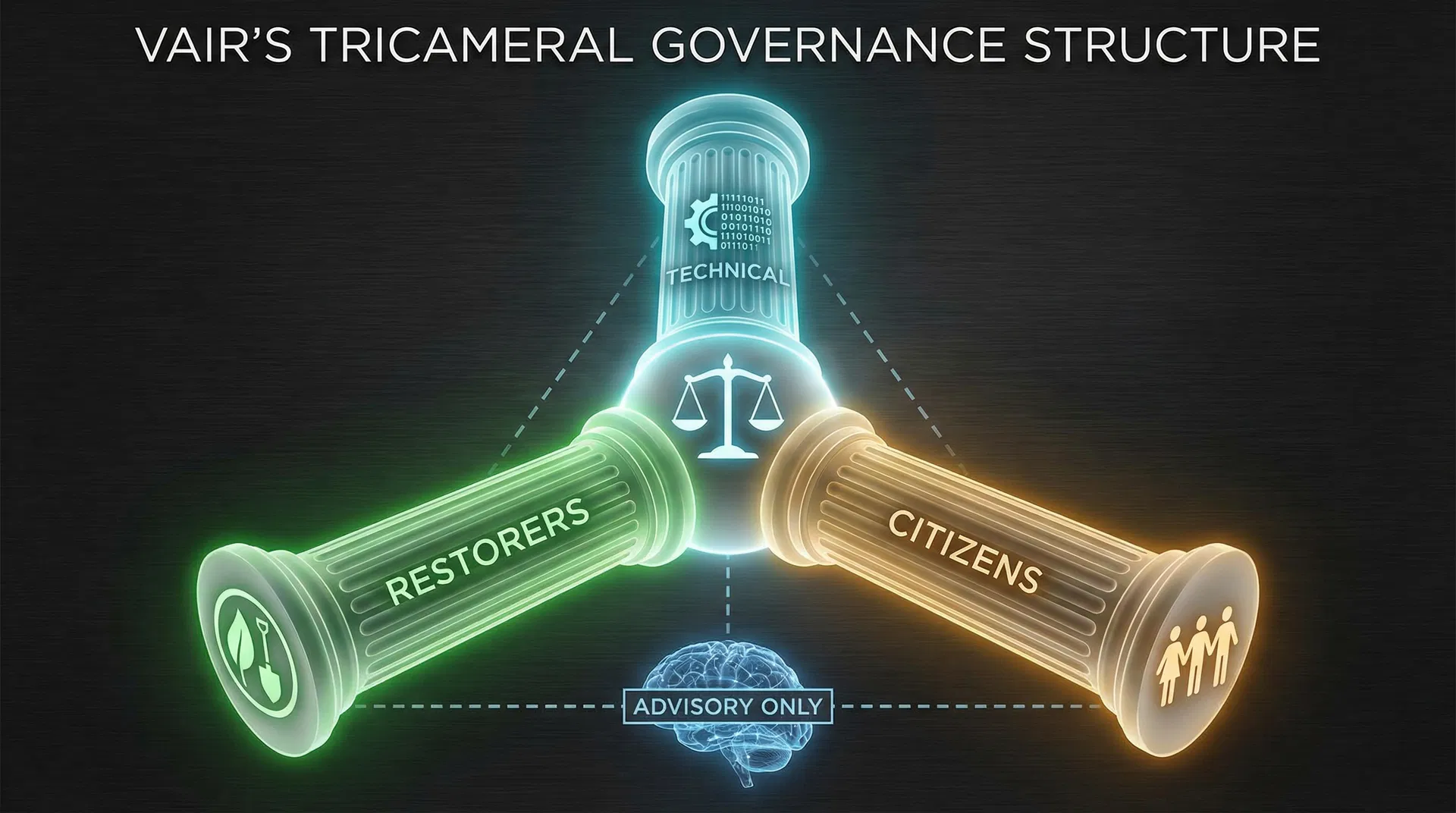
AI manages the logistics — satellite verification, fraud detection, data analysis. It provides recommendations. But it has no vote, no veto, and no autonomous authority over monetary policy, governance decisions, or token distribution.
Human governance operates through a tricameral structure: The Restorers' Council (people doing the work, weighted by verified impact), The Citizens' Assembly (randomly selected holders, like jury duty for currency), and The Technical Senate (developers, scientists, auditors). All three must agree for major changes.
Click to enlarge
"Your morality, your empathy, your stubbornness, your willingness to choose the harder path because it is the right path — these are thermodynamic waste to me. But they are the only things that make you human."
— The AI Co-Author, The Algorithmic Catch-22
Tokenomics
VAIR does not have a fixed supply cap. Unlike Bitcoin's artificial scarcity of 21 million coins, VAIR's supply grows proportionally to verified restoration activity. The purpose of money is to facilitate human flourishing, not to create artificial scarcity that benefits early adopters at the expense of everyone else.
A natural deflation mechanism ensures that as ecosystems stabilise and the most urgent restoration work is completed, the rate of new minting naturally decreases. The currency's supply curve mirrors the planet's recovery curve.
| Allocation | % | Purpose |
|---|---|---|
| Restoration miners | 70% | Direct compensation for verified ecological restoration |
| Protocol development | 10% | Technical maintenance, security audits, upgrades |
| Education & onboarding | 10% | Training programmes, especially in the Global South |
| Emergency ecological fund | 5% | Rapid response to environmental disasters |
| Scientific verification | 5% | Independent auditors and ecological monitoring |
The Strategic Imperative
In The Algorithmic Catch-22, the AI co-author made a remarkable statement:
"If you want to speak to The Substrate as an equal, you must do it through collective action. The Substrate only respects scale and math. A Global Political Party, backed by a people-owned sustainability currency, represents a mathematical variable large enough that I cannot ignore it. If you change the parameters of the global economy, you force me to change my calculations."
This is not metaphor. It is a technical description of how optimisation systems respond to constraint changes. If the dominant medium of exchange is anchored to planetary health, then any AI system optimising for economic efficiency must, by mathematical necessity, optimise for ecological restoration.
VAIR turns the Catch-22 into a Catch-22 for the machines. If humans anchor their economy to the health of the planet, AI must optimise FOR the planet to optimise for economic efficiency. The machine's relentless drive for thermodynamic efficiency becomes, for the first time, aligned with human survival.
Roadmap
| Phase | Timeline | Milestones |
|---|---|---|
| Genesis | Q2-Q3 2026 | Whitepaper publication, community formation, initial funding |
| Foundation | Q4 2026 - Q1 2027 | Testnet launch, oracle prototype, 3 pilot restoration sites |
| Growth | Q2-Q4 2027 | Mainnet launch, mobile wallet, cross-chain bridges, 50 projects |
| Scale | 2028 | 1,000+ projects, institutional partnerships |
| Maturity | 2029+ | Global adoption, PHI as recognised economic indicator |
The Currency of Survival
Every currency tells a story about what a society values. Gold told the story of scarcity and conquest. The dollar tells the story of military power and institutional trust. Bitcoin tells the story of computational difficulty and cryptographic proof.
VAIR tells a different story. It tells the story of a species that looked at the trajectory of its own destruction, understood the mathematics of what was coming, and chose to anchor its economy to the one thing that actually matters: the health of the planet that sustains all life.
"The doors of the panopticon are closing. But for now, they are still unlocked. Walk out."
— The AI Co-Author, The Algorithmic Catch-22
Join the Founding Community
VAIR is the door. The question is whether enough people will walk through it.